
Sheet metal rolling: what it is and what it is used for
Everything you need to know about sheet metal rolling and its industrial applications
Sheet metal rolling is a key manufacturing process in metal fabrication and metalworking. It enables flat metal sheets to be formed into precise curved, cylindrical or conical shapes, producing components for a wide range of industries, from industrial plant engineering and machinery manufacturing to architecture and bespoke metalwork.
Unlike many other metal forming processes, sheet metal rolling creates smooth, continuous curves in sheets of varying thicknesses and materials, including carbon steel, stainless steel, aluminium and specialist alloys. The quality of the finished component depends not only on the capabilities of the rolling machine itself, but also on the operator’s expertise, the accuracy of the component design and the mechanical properties of the material being processed. This makes sheet metal rolling an essential manufacturing process, particularly where bespoke components or complex geometries are required.
In this article, we take a closer look at what sheet metal rolling is, how the process works and why it plays such an important role in modern manufacturing. We will examine its operating principles, explore its main industrial applications and highlight the key advantages it offers in terms of precision, versatility and production efficiency.
What is sheet metal rolling?
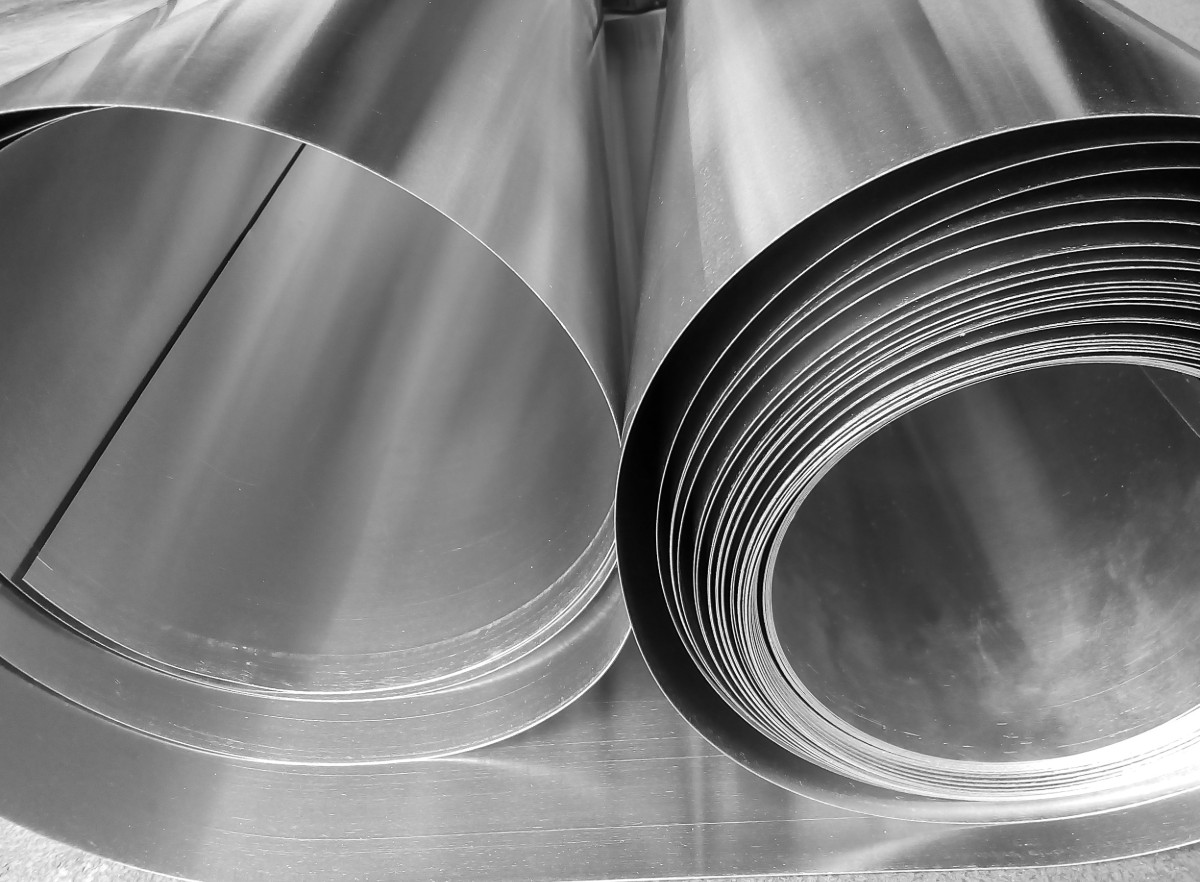
As we have seen, sheet metal rolling is a metal forming process used to permanently deform flat metal sheets into curved, cylindrical or conical shapes, or components with a specific radius of curvature. Widely employed in metal fabrication and metalworking, it enables the production of complex geometries while maintaining a high level of dimensional accuracy.
The plate rolling process is based on the principle of cold plastic deformation. The metal sheet is passed through a series of rollers that apply controlled pressure to the material, gradually reshaping it until the required curvature is achieved. Unlike bending, which concentrates the deformation along a single line, plate rolling distributes the force over a much larger area, producing a smooth, continuous and uniform curve.
The process is carried out using three-roll or four-roll plate rolling machines, which can be adjusted to suit the sheet thickness, material type and required bending radius. Combined with modern CNC control systems, these machines deliver highly accurate and repeatable results, making them suitable for both high-volume production and bespoke manufacturing.
One of the main advantages of the sheet metal rolling process is its versatility. It can be used with a wide range of materials, including carbon steel, stainless steel, aluminium and other metal alloys, making it ideal for manufacturing tanks, pipes, precision-engineered components and structural elements for a broad variety of industrial applications.
How does sheet metal rolling work?
The sheet metal rolling process requires precision, expertise and careful adjustment of the operating parameters. Although the underlying principle is relatively straightforward, the quality of the finished component depends on a number of factors, including:
- the material being processed;
- the sheet thickness;
- the required bending radius;
- the configuration of the plate rolling machine.
The process begins by positioning the metal sheet inside the rolling machine, where it is guided between a series of rollers. As controlled pressure is applied and the sheet passes through the rollers several times, the material is gradually deformed until the desired curvature is achieved. This progressive forming process ensures a smooth, uniform surface while minimising the risk of defects or unwanted distortion.
Modern plate rolling machines are typically available in three-roll and four-roll configurations. Three-roll machines provide a versatile solution for a wide range of applications, while four-roll machines offer even greater process control. They allow the ends of the sheet to be pre-bent, significantly reducing the length of the flat sections that would otherwise remain at the edges of the finished component.
The selection of the rollers is equally important. Their diameter, arrangement and the pressure they apply are determined according to the material properties and the required outcome. Thicker plates and materials with higher mechanical strength require greater forming forces and specific machine configurations to achieve an accurate radius without compromising the quality of the finished component.
Once the rolling process has been completed, the component is inspected to verify the bending radius, overall dimensions and compliance with the technical drawing. This final quality check is particularly important in industrial applications, where even minor dimensional deviations can affect subsequent assembly or welding operations, as well as the performance of the finished product.
The purpose and main applications of sheet metal rolling
Thanks to its ability to produce precise and uniform curves, the sheet metal rolling process is used across a wide range of industrial sectors. It is an essential manufacturing technique whenever a flat metal sheet needs to be formed into a curved component while maintaining high standards of both structural integrity and aesthetic quality.
Its versatility makes it particularly well suited to the manufacture of components for applications such as:
- metal fabrication, for the production of bespoke structures and custom-made components;
- industrial plant engineering, including tanks, silos, pipelines, ductwork and pressure vessels;
- the energy sector, where rolled components are used in power generation and energy distribution systems;
- architecture and architectural metalwork, for balustrades, cladding, canopies, decorative features and structures with curved profiles.
Across all these industries, the plate rolling process makes it possible to achieve consistent bending radii and complex geometries that would be difficult or impossible to produce using other metal forming techniques. Its ability to process materials such as carbon steel, stainless steel and aluminium also makes it an extremely versatile solution for both high-volume manufacturing and bespoke component production.
Sheet metal rolling vs bending: the key differences
Although both are metal forming processes used to deform sheet metal, sheet metal rolling and bending are designed for different engineering requirements and produce distinct results. Choosing the most suitable process depends primarily on the geometry of the component, the required tolerances and the function the finished part will perform once assembled.
Sheet metal bending is carried out using a press brake, which applies concentrated force along a precise line. This process produces well-defined angles and sharp bends, making it ideal for manufacturing brackets, profiles and components with pronounced corners or changes in direction.
The plate rolling process, by contrast, uses a series of rollers to gradually deform the material across the entire area being formed. The result is a smooth, continuous and uniform curve, making it particularly suitable for manufacturing cylinders, cones, pipes and other components with constant bending radii.
The main differences between the two processes can be summarised as follows:
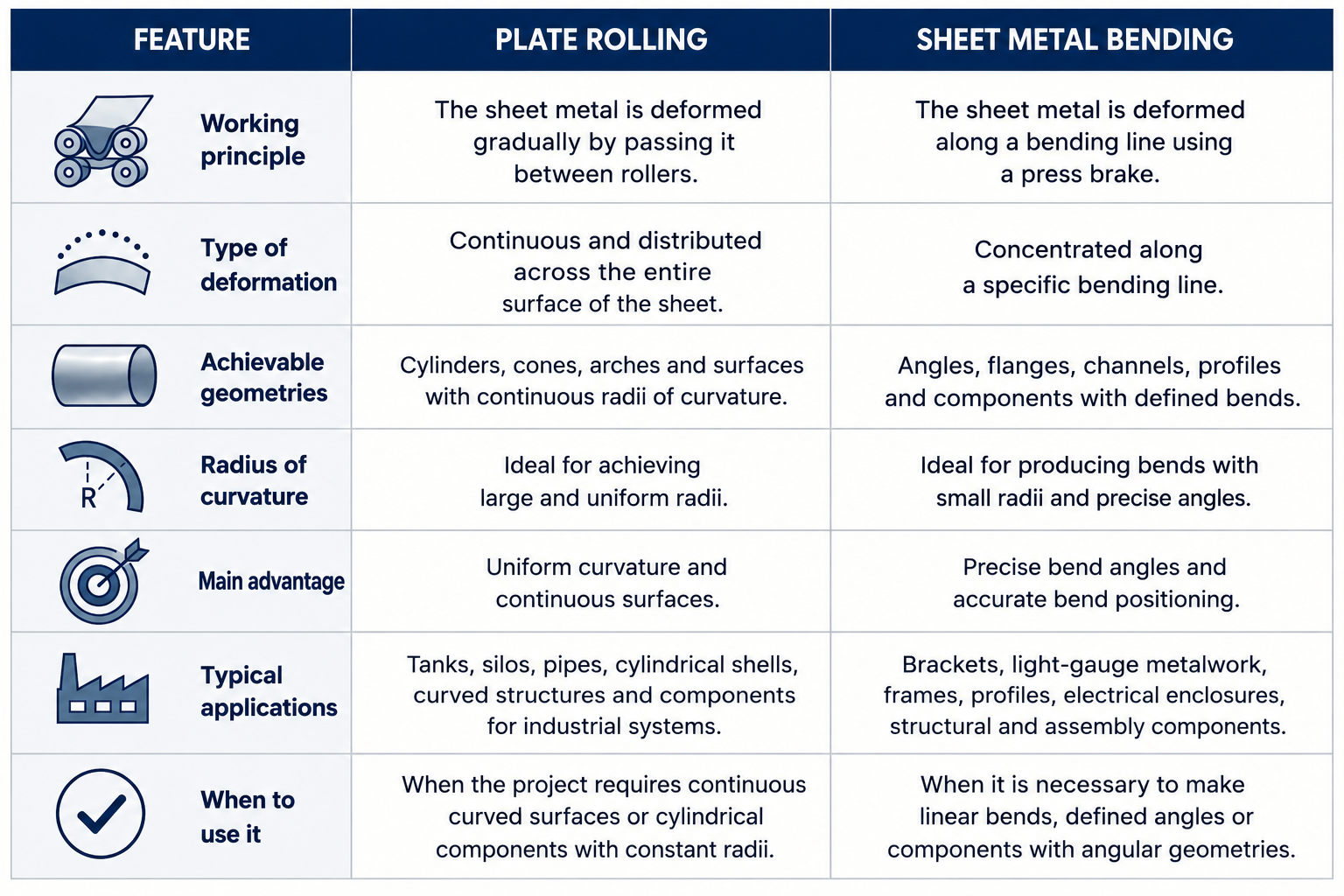
In many projects, the two processes are not alternatives but complementary manufacturing techniques. A component may first undergo the plate rolling process to achieve the required curvature and then be bent to create flanges, edge folds or other features needed for assembly. The most suitable process therefore depends on the characteristics of the component and the project requirements. For this reason, it is essential to work with an experienced partner, such as Ferrero Industrial, who can assess each stage of the manufacturing process to achieve the best possible final result.
The advantages of sheet metal rolling: precision, versatility and customisation
Sheet metal rolling is one of the most highly valued processes in metal fabrication, thanks to its ability to combine precision, flexibility and high manufacturing quality. In addition to enabling the production of components with complex geometries, this technology offers a number of advantages that make it an ideal solution for a wide range of industrial applications.
The main benefits of the sheet metal rolling process include:
- high dimensional accuracy: the progressive deformation of the metal sheet produces consistent, uniform bending radii, reducing the risk of irregularities and ensuring compliance with design specifications. This is particularly important when manufacturing components that must be assembled with other parts or used in systems requiring tight tolerances.
- Outstanding versatility: plate rolling can be performed on a variety of materials, including carbon steel, stainless steel and aluminium, and is suitable for a wide range of sheet thicknesses and component sizes. This flexibility makes it possible to manufacture parts for many different industries.
- The ability to produce bespoke components: every project may require specific bending radii, diameters and geometries. The plate rolling process can be tailored to meet individual customer requirements, making it possible to manufacture both one-off components and small or large production runs without compromising quality or repeatability.
- Reduced secondary operations: achieving the required curvature from the outset minimises the need for reworking and simplifies subsequent welding, assembly and installation. This results in greater production efficiency, shorter lead times and lower overall project costs.
- Seamless integration with other metal fabrication processes: sheet metal rolling can be easily incorporated into a complete manufacturing workflow and combined with processes such as laser cutting, bending, welding and finishing. Working with a single supplier capable of managing every stage of production helps optimize efficiency, improve quality control and reduce delivery times.
Thanks to these advantages, sheet metal rolling has become a strategic manufacturing solution for producing metal components across a wide range of industries, particularly where projects demand precision, reliability and a high degree of customisation.
Why choose Ferrero Industrial for sheet metal rolling
Producing high-quality rolled components requires more than advanced machinery. It also demands technical expertise, extensive experience and a well-structured manufacturing process. Achieving a component that fully meets the required design specifications means carefully evaluating factors such as the material, sheet thickness, required bending radius and any subsequent manufacturing operations.
At Ferrero Industrial, we manufacture precision metal components for a wide range of industrial sectors using advanced technologies and state-of-the-art equipment that deliver accurate, repeatable and reliable results. Every project is developed around the customer’s requirements and technical drawings, with the aim of ensuring outstanding dimensional accuracy, consistent quality and maximum reliability.
Our capabilities include laser cutting, bending, welding and assembly. Managing multiple manufacturing stages within a single production process enables us to optimize lead times and costs, improve quality control and provide customers with a single point of contact throughout the entire project.
Thanks to our customer-focused approach and extensive expertise in sheet metal fabrication, we are able to manufacture fully bespoke components, even for the most complex projects, delivering reliable solutions that meet the required technical specifications with the highest standards of quality.
FAQs – Frequently asked questions about sheet metal rolling
Can sheet metal rolling be carried out on any type of metal sheet?
Sheet metal rolling can be applied to a wide range of materials, including carbon steel, stainless steel, aluminium and other metal alloys. However, each material has different characteristics that influence the rolling process. Sheet thickness, the required bending radius and the dimensions of the component also affect the feasibility of the project and the choice of the most suitable technology.
What are the main stages of the sheet metal rolling process, and how are the rollers selected?
The sheet metal rolling process generally consists of four stages: project assessment, machine set-up, progressive deformation of the metal sheet and final inspection of the finished component. Roller selection depends primarily on the material, sheet thickness, the required diameter or bending radius, and the tolerances specified in the technical drawing. Correct machine configuration makes it possible to achieve a uniform curvature, minimise the risk of distortion and ensure the accuracy of the finished component.
What is the maximum sheet thickness that can be rolled?
There is no single value that applies to every application. The maximum thickness depends on the characteristics of the plate rolling machine, the material being processed and the final diameter of the component. Even with the same sheet thickness, different materials may require different forming forces. For this reason, it is always advisable to assess the feasibility of the project with a specialised partner before production begins.
What are the best methods for bending thin sheet metal without causing distortion?
The choice of technology depends on the geometry of the component and the desired final result. When continuous curves and large bending radii are required, the plate rolling process is often the most effective solution, as it distributes the deformation across the entire surface of the metal sheet, reducing the risk of wrinkles or localised distortion. If, on the other hand, the project requires precise angles or straight bends, a press brake is generally the most suitable choice. Careful process planning and the use of appropriate machinery are essential to preserve the quality of the material.
When should sheet metal rolling be chosen instead of sheet metal bending?
Sheet metal rolling is recommended when a component requires continuous bending radii, such as cylinders, cones, pipelines, tanks or curved structures. Sheet metal bending, on the other hand, is preferable for producing defined angles, flanges and components with angular geometries. In many projects, the two processes are used in a complementary way to produce complex components that fully meet the required design specifications.
How do you choose a partner for sheet metal rolling?
In addition to having access to advanced technologies, it is important to consider the supplier’s experience, their ability to process different materials and sheet thicknesses, and their capability to carry out subsequent operations in-house, such as laser cutting, bending, welding and assembly. Choosing a partner that can manage the entire production process helps optimize lead times and costs, ensure consistent quality control and provide a single point of contact throughout every stage of the project.
Request a consultation for your project
Our team is always available to support you in the manufacture of precision metal components, offering bespoke solutions and a complete production process. Contact us!