

The role of robotics in industrial carpentry production
Robotic automation: the key to innovating the metalwork industry
Industrial robotics is completely transforming the metalwork industry, introducing substantial improvements in productivity, accuracy, and workplace safety. Integrating robotic automation systems into the production of metal components and structures has become essential for companies wishing to maintain a competitive advantage in the market.
Let’s see together what is meant by robotics and industrial automation, what are the main types of industrial robots, their specific applications and the concrete benefits they can ensure in the production of metal carpentry.
What are robotics and industrial automation?

Industrial robotics involves the use of programmable robots to perform repetitive, complex, and sometimes dangerous tasks within production environments. These robots are designed to perform operations that require not only high accuracy, but also the ability to work in difficult or demanding work environments, such as high temperatures, harsh chemicals, or confined spaces that are difficult for operators to access. Furthermore, being programmable and equipped with advanced sensors, industrial robots can quickly adapt to changes in the production cycle, increasing the operational flexibility of the systems.
At the same time, industrial automation also includesand the use of intelligent digital software and systems that enable real-time data collection and analysis. These data allow for precise monitoring and optimal management of production operations, reducing waste and downtime and significantly improving plant energy efficiency. In this way, in addition to increasing productivity and quality, these technologies concretely contribute to environmental sustainability and continuous innovation in the industrial sector.
The main types of industrial robots
In the metalwork sector and, more generally, in the manufacturing industry, various types of industrial robots can be used, each designed to meet specific needs. Among these we find:
- cartesian robots: they move along orthogonal linear axes (X, Y and Z) and are often used in carpentry plants for the movement of sheet metal, metal profiles and large semi-finished products. Their structure ensures high precision and large load capacity, making them particularly suitable for machine loading and unloading operations, heavy component placement, and integration with CNC machining centers. They are less flexible than anthropomorphic robots, but extremely reliable for repetitive processes over large volumes.
- anthropomorphic (or articulated-arm) robots: they are the most widespread in metalwork due to their high flexibility. They generally have 6 to 7 axes of movement, which allow the movements of the human arm to be replicated with great precision. This feature makes them ideal for complex operations such as MIG/MAG and TIG welding, laser or plasma cutting, deburring, grinding and painting of even large metal structures. They can operate in confined spaces and reach difficult-to-access points, maintaining high repeatability and process quality, essential for medium-heavy carpentry.
- SCARA (Selective Compliance Assembly Robot Arm) robots: Although less common in heavy metalwork, SCARA robots can find application in the mechanical assembly of precision metal components and the rapid handling of small and medium-sized workpieces. They offer high speed and precision in the horizontal plane, making them ideal for repetitive operations where a certain controlled elasticity on the vertical axis is required, such as the insertion of pins, screws or metal fasteners.
- Delta robots: characterized by parallel arms that allow extremely fast and accurate movements, they are particularly suitable for lightweight high-speed applications, such as pick-and-place;
- collaborative robots (cobots): increasingly present even in light metalwork, cobots are designed to work safely alongside human operators. They are used in activities such as precision welding, assembly, dimensional checks and surface finishing, especially on small batches or variable production. Although they have a shorter range than traditional robots, they offer great flexibility, ease of programming and quick reconfiguration times, and are therefore ideal for companies oriented towards product customization.
The integration of the most suitable type of robot allows for the optimization of every phase of the production process, reducing cycle times and ensuring consistent results even in the most complex processes.
Applications of robots in industrial metalwork
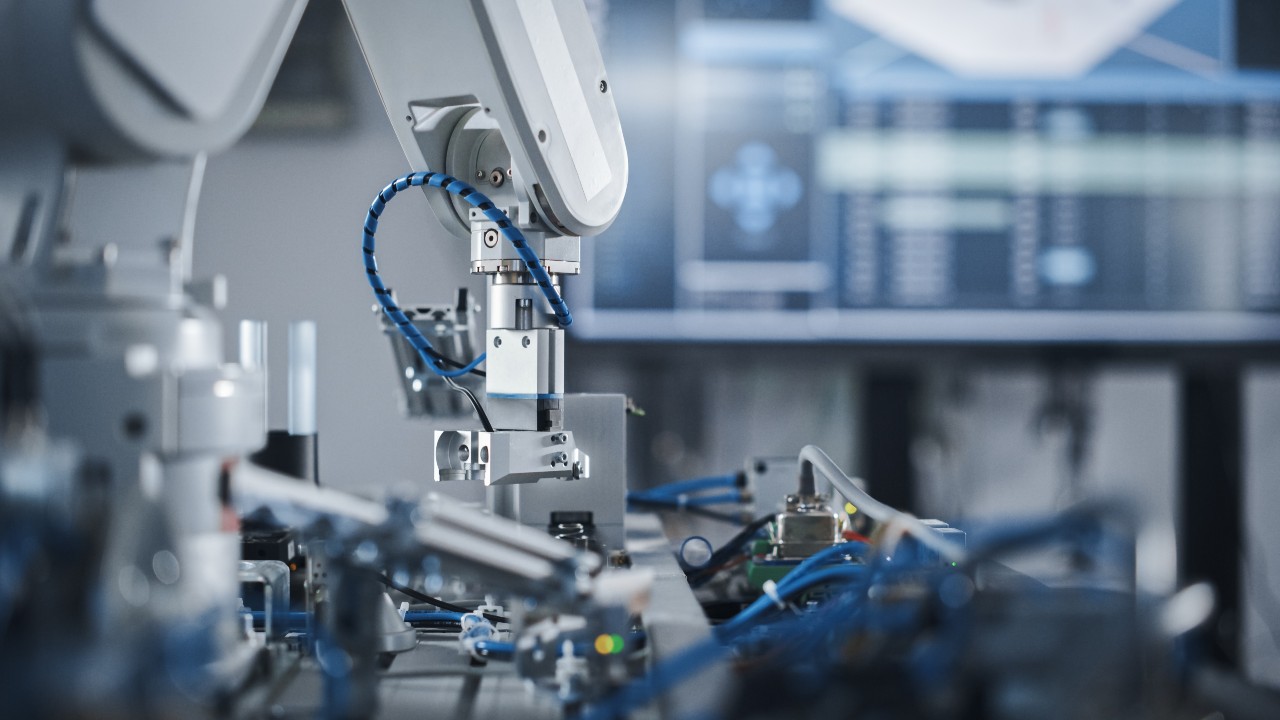
In industrial metalwork, the use of robots represents one of the main factors in the evolution of production processes because it allows for the automation of traditionally complex, laborious, and high-risk processes for operators. Industrial robots find application at various stages of production, starting with welding operations, where they ensure repeatable, high-quality results even on large metal structures or complex geometries, significantly reducing waste and improving the mechanical strength of joints.
Another fundamental application is metal cutting, performed using technologies such as lasers, which allows for high dimensional accuracy, speed of execution, and optimized material utilization, even on thick sheet metal or structural profiles. Robots are also widely used in the handling of workpieces, handling the loading and unloading of machine tools, the positioning of heavy components, and the transfer of semi-finished products between different phases of the production cycle, improving safety and reducing the risk of injuries related to manual handling.
Industrial carpentry also features mechanical assembly applications, where robots ensure precision in the assembly of metal structures, frames, and subassemblies, maintaining tight tolerances and production uniformity even over large volumes. An increasingly important role is also played in surface finishing operations, such as grinding, satin finishing, and painting, where the consistency of robotic movement ensures uniform surfaces and high aesthetic quality, difficult to achieve with prolonged manual processing.
Finally, the robots are used in quality control and inspection activities, integrating vision systems and sensors to verify dimensions, welds, and surface defects, allowing continuous monitoring of the production process. Overall, robot applications in industrial carpentry help increase the efficiency, safety, and competitiveness of companies, enabling more flexible, precise, and sustainable production even in highly complex environments.
The advantages of robotics for industrial carpentry
As we have seen, the integration of robotics into industrial carpentry represents a strategic evolution for companies operating in metalworking, as it allows for significant improvements in production efficiency, product quality, and workplace safety. The use of industrial robots allows for the automation of complex and repetitive operations, transforming traditional processes into highly controlled, flexible, and competitive systems. Here are the main advantages of robotics applied to metalwork:
- increased productivity and business continuity: industrial robots can operate continuously, even over multiple shifts, ensuring constant duty cycles and reduced production times. In the production of metalwork this results in greater order fulfillment capacity, reduced downtime and improved plant utilization, especially in welding, cutting and handling work.
- Consistent quality and increased precision: robotics ensures high repeatability and precision in machining, fundamental elements in the production of metal structures that require tight tolerances and high quality standards. Operations such as welding, cutting, and assembly are uniform across each piece produced, reducing defects, rework, and scrap, resulting in improved reliability of the final product.
- Improved safety at work: one of the most relevant benefits is the reduction of operator exposure to high risks. Robots can perform hazardous tasks such as welding, cutting at high temperatures, handling heavy loads, or machining in harsh environments, reducing the risk of injury and improving overall working conditions within factories.
- Reducing operating costs in the medium to long term: while the initial investment can be significant, robotic automation enables cost reduction over time by reducing waste, reducing rework, and optimizing raw material use.
- Increased production flexibility: modern robotic systems can be reconfigured and reprogrammed with relative ease to adapt to new products, size variations, or small batches. This aspect is particularly advantageous in industrial carpentry, where standard production often alternates with customized orders, allowing companies to respond quickly to market demands.
- Better integration with digital systems and Industry 4.0: industrial robots can be integrated with design software, vision systems, sensors, and monitoring platforms, allowing for advanced control of production processes. This promotes data collection and analysis, predictive maintenance, and continuous machining optimization, making metalwork smarter and more interconnected.
How Ferrero Industrial applies advanced manufacturing technologies and robotic processes in metalwork
Ferrero Industrial integrates innovative technologies and robotic systems into its production process to ensure maximum precision, efficiency and quality in the production of industrial metalwork and precision components. The heart of production is based on advanced machinery for cutting, bending and welding materials, coupled with automated systems that reduce errors and optimize cycle times.
We use laser systems of variable power (8 kW, 6 kW and 4 kW) equipped with automatic loading and unloading systems and nozzle changes, which allow high-precision cuts to be performed on sheet metal and workpieces of different geometries and thicknesses quickly and efficiently, minimizing processing waste. Our machine fleet also includes robotic bending cells, where a robotic arm interfaced with press brakes ensures angle control and uniformity of bends over large formats, improving the dimensional reliability of structural components.
For welding, we use a series of welding robots with 6 controlled axes and PMC (Pulse Multi Control) technology, which allow us to perform complex joints with extreme precision and repeatability, essential for the most critical industrial applications such as components for drilling machines, aerial work platforms, telescopic handlers and car carrier trailer parts. This robotic approach not only improves the quality of welded joints, but also allows for greater production flexibility, allowing lines to be quickly adapted to different orders in both serial and customized batches.
Overall, the application of advanced manufacturing technologies and robotic processes ensures high levels of precision and reliability in metalwork production, while supporting continuous innovation and operational efficiency in compliance with industry regulations and international certification standards.